Virtual team building for engineering teams that actually works
 Tom Fitzgerald
August 6, 2026
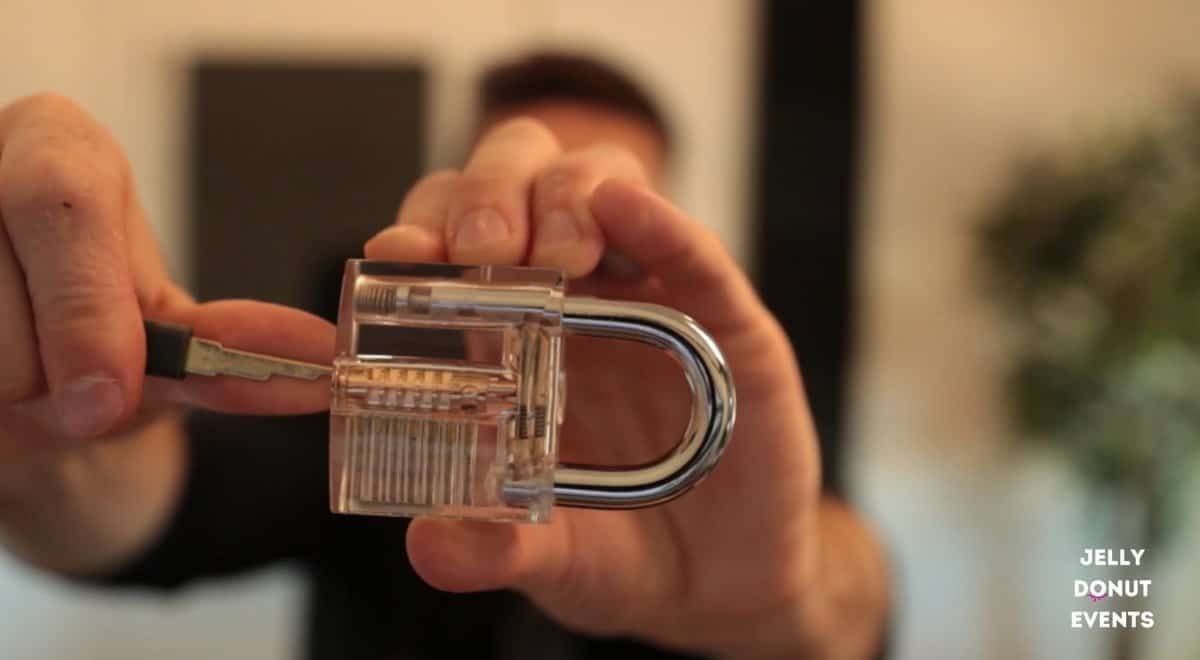
I’m going to show you how to move past awkward Zoom happy hours and engage your engineers with tactile, problem-solving workshops. The kind of events that don’t make people secretly wish they were just closing out another ticket. It’s a common problem, and one I’ve spent years thinking about.
In this guide
Why engineering teams hate most virtual team building
I have noticed that developers often view team building as a distraction from their actual work. It’s not that they are antisocial. It’s that their time is structured, logical, and focused on solving complex problems, and most corporate-mandated “fun” is the complete opposite of that. An hour spent on a half-hearted trivia game is an hour they could have spent in deep focus, and they feel that loss keenly.
Most virtual events rely on awkward small talk that feels like a forced social performance. You get put into a breakout room and are expected to instantly generate rapport with a colleague you only know through Slack avatars. It’s an ambush. Engineers, in my experience, generally prefer activities with clear rules and a logical progression over vague social goals. They want to know the objective, the constraints, and the win state. “Getting to know each other better” is not a measurable outcome.
Passive participation is the other killer. Watching a screen, clicking a poll, or typing an answer into a chat for a trivia game is just another hour of staring at a monitor without actually doing anything. It doesn’t break the monotony of remote work; it just replaces one type of screen time with another, slightly less productive, type. They want to use their hands and their brains, not just their eyes.
The problem with forced fun
There’s a fundamental misunderstanding in how many companies approach team morale. Socializing over a group chat or a scheduled video call often feels like more work rather than a genuine break. It’s another performance, another calendar slot to manage. Forced participation, where attendance is mandatory, can create a quiet resentment that undermines the entire goal. Instead of fostering connection, it makes people feel managed and patronized.
I prefer to give teams a challenge where the social bond happens as a byproduct of solving a shared problem. You don’t have to ask people about their weekend when you’re both trying to figure out why the third pin in a lock won’t set. The conversation becomes natural, focused, and collaborative. The fun isn’t forced; it emerges from the process itself.
Why small talk fails remote developers
In an office, small talk happens organically. You run into someone at the coffee machine or while walking to a meeting. Remote work lacks that natural context for casual conversation, and trying to replicate it on a scheduled call feels stilted and strange. It’s like trying to script spontaneity.
Engineers often bond more effectively through shared technical hurdles than personal disclosures. They build camaraderie by untangling a nasty bug together or debating the merits of a new framework. The connection is built on mutual respect for each other’s problem-solving skills. I focus on activities that provide a shared narrative through a specific, tangible skill. Learning something new together creates a common ground that feels more substantial and relevant than simply sharing personal anecdotes on command.
Criteria for engaging a technical mindset
A successful activity for engineers must include a tactile or kinesthetic element. It has to get them away from the keyboard and mouse. Getting people to use their hands is the fastest way to break the passive-spectator mode that plagues so many virtual events. It engages a different part of the brain and demands a level of focus that a purely digital activity can’t match.
The challenge should also have a progressive difficulty curve that respects different skill levels. You need early wins to build confidence and prevent frustration, but you also need increasing complexity to keep the fastest learners from getting bored. It’s a careful balancing act. The goal is to get everyone into a state of “flow,” where the challenge is perfectly matched to their ability, and the outside world just melts away for an hour.
I also look for events that offer a clean metaphor for the work they do every day. The activity shouldn’t feel random or disconnected from their professional lives. When the team-building exercise mirrors the rhythms of debugging, system analysis, or creative problem-solving, it feels less like a distraction and more like a form of professional development. Finally, the experience needs to feel like a hobby or a secret skill rather than a corporate exercise. It should be genuinely interesting, something they might actually talk about or show someone later. Nobody is going to show their family how they answered a trivia question, but they will absolutely show them how they can open a lock with a paperclip.
The importance of tactile feedback
Using your hands drives focus in a way a slide presentation or a multiple-choice poll never will. When you are holding a physical object, manipulating it, and feeling for subtle feedback, your attention is completely captured. Physical tools provide immediate, unambiguous feedback that digital games cannot replicate. A pin is either set, or it is not. The lock is either open, or it is closed. This direct relationship between action and outcome is incredibly satisfying for a technical mind. I find that people stop checking their email or Slack notifications when they have a physical lock in their hands. The screen becomes secondary to the object in front of them.
Progressive challenges and early wins
When I teach a new skill, I always start with very simple tasks to build confidence before moving to more complex systems. In our lock picking team building activity, for example, we begin with a transparent practice lock where you can see every moving part. This demystifies the process and provides an immediate, visible win. That first “click” is a powerful moment.
But you can’t stay there. Fast learners need harder puzzles to stay engaged while others are still getting the hang of the basics. That’s why our kits include multiple locks of increasing difficulty. This allows people to progress at their own pace, ensuring no one feels left behind and no one gets bored. The ultimate goal is to help everyone reach a state of flow, that perfect mental space where the challenge is so engrossing that the outside world disappears for an hour.
How lock picking mirrors the debugging process
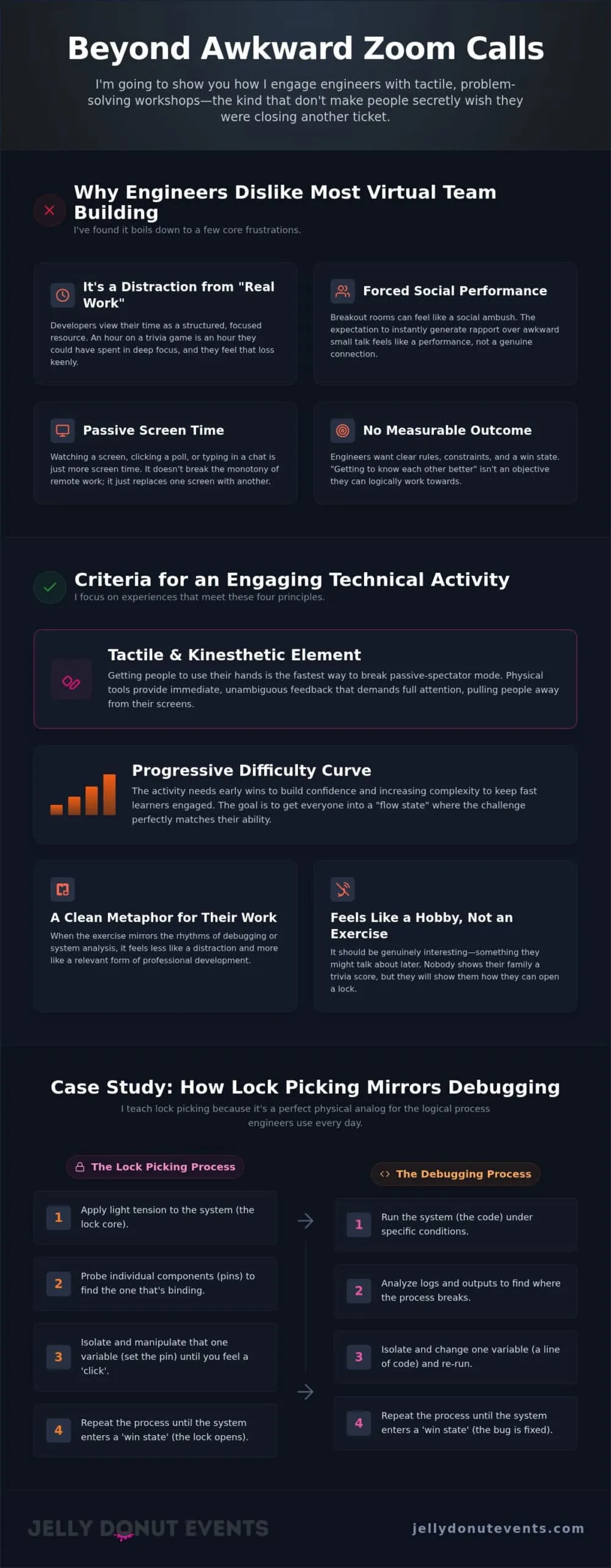
I teach lock picking because it is a physical version of finding a bug in a system. When you’re debugging code, you can’t always see the internal state of the program. You have to rely on logs, error messages, and intuition to build a mental model of what’s going wrong. Lock picking is exactly the same. You cannot see inside the lock, so you have to rely on subtle feedback transmitted through the pick and the tension wrench. You’re feeling for tiny clicks and shifts in the mechanism to understand its internal state.
The process illustrates how to break a complex problem down into smaller, manageable parts. You don’t just “open the lock.” You find the first binding pin, you set it, you feel for the slight rotation of the core, and then you move to the next. It’s a sequential, methodical process of elimination, just like troubleshooting a software issue. In the digital realm, teams often use platforms like Kilden to gain that same level of granular insight into how their systems and users are interacting. It also fosters a deep, practical appreciation for physical security, a topic that is highly relevant to software engineers who spend their days building secure digital systems. It connects the abstract world of code to the physical world of vulnerabilities.
Decoding the feedback loop
The parallels to coding are surprisingly direct. Just like in code, if you apply too much tension to the lock core, you will bind everything up and stall the process. Too little tension, and the pins you’ve set will drop back down when you move to the next one. It’s a delicate balance. Participants learn to listen for the “click” of a pin setting, which is the physical equivalent of a successful unit test. It’s a clear signal that one small part of the problem has been solved.
I particularly enjoy watching a developer have the realization that patience and finesse are more effective than brute force. They start out trying to jam the pick in, but soon discover that the solution lies in subtle movements and paying close attention to feedback. It’s a lesson in diagnostics that applies just as well to a tricky software bug as it does to a five-pin cylinder.
Security awareness as team building
This workshop is more than just a game; it serves as a practical lesson in physical penetration testing. It gives software developers a tangible understanding of how security mechanisms can be bypassed. This hands-on experience changes how a team views the security of the systems they build. Suddenly, security isn’t just an abstract requirement in a project plan; it’s a real, physical thing that can be methodically defeated.
I often frame the class as a security exercise to get buy-in from skeptical managers or HR departments. It’s not just “fun,” it’s a form of kinesthetic learning that reinforces a security-first mindset. It’s a way to teach a crucial technical concept without a single PowerPoint slide. For those who want to explore the skill in more depth, there are some great resources out there that cover the topic from beginner to advanced levels, like this guide to virtual lock picking classes.
Logistics of shipping kits to a global team
One of the biggest hurdles for any hands-on virtual event is logistics. We’ve spent years refining our process and now handle the shipping of full lock picking kits to eight different countries. We’ve learned that timing is everything. Kits are sent out with the goal of arriving about two weeks before the event to ensure everyone is ready on time, building a bit of buffer for any local carrier delays. The flat $79 price for our lock picking workshop is all-inclusive, covering the kit itself and delivery for most addresses in the US, Canada, and the UK.
For the event itself, all you need is a good internet connection. I recommend using a platform like Zoom or Microsoft Teams for the best multi-camera experience, as our setup allows you to see my hands working on a lock up close while also seeing my face. It makes the instruction clear and easy to follow, no matter where your team members are located.
Planning your shipping timeline
Our standard lead time is two weeks to get everything sorted and shipped. For groups with international attendees, we just recommend allowing some additional time for the kits to clear customs, as that part of the journey can be a little unpredictable. The kits are designed to be compact and clear customs easily, but it’s always good to have a small buffer.
To make the process as simple as possible for the organizer, we use a branded, secure landing page to capture all the shipping addresses. This means the manager doesn’t have to chase down addresses and compile a spreadsheet. The team members enter their own information, and we handle the rest. The kits arrive directly at their door and are theirs to keep permanently, which is a nice perk that people appreciate.
International reach and surcharges
We currently ship to the USA, Canada, UK, Ireland, Spain, Portugal, Germany, and France. We’ve built a reliable network to get kits to these locations efficiently. Very rare surcharges only apply for extremely remote locations that are far from major shipping hubs, and we are always upfront about those if they apply. The kits themselves are designed with a virtual audience in mind. I make sure they include high-quality transparent locks so the inner mechanics are clearly visible over video, making it much easier for beginners to understand what’s happening inside as they learn.
Alternative hands-on ideas for lower intensity days
Sometimes a high-focus, intense activity like lock picking isn’t quite the right fit for the moment. If you’re looking for something with a similar sensory focus but a more relaxed pace, a virtual coffee tasting can be a perfect alternative. It still involves a shipped kit and a hands-on, tactile experience, but the energy is calmer and more conversational.
Coffee workshops still appeal to a technical mindset because they involve details like extraction times, water temperature, and grind size that engineers appreciate. It’s a scientific process. Similarly, a latte tasting session provides a relaxed and sophisticated environment for teams to connect over a shared craft. These sessions still use shipped kits to maintain that important tactile connection, ensuring everyone is engaged with something other than their screen.
The science of the brew
In our coffee events, we explore different flavor profiles through a guided sensory experience. It’s not just about drinking coffee; it’s about deconstructing it. Our professional facilitators lead the team through the same logic and vocabulary used in professional “cupping” competitions. Participants learn to identify notes of citrus or chocolate, to understand the difference between body and acidity, and to appreciate the chemistry behind a perfect brew. It’s a great way to have a sophisticated break that still feels like a structured, educational event.
Choosing the right event for your group
Frequently asked questions
Is virtual lock picking legal for my team to do? Yes. The legality of owning lock picking tools is straightforward in most places. The key is intent. As long as you are using them on locks that you own for educational or recreational purposes, you are not breaking any laws. We are teaching a puzzle-solving skill, not how to commit a crime.
How many people can participate in a single virtual event? We’ve designed our workshops to be highly scalable. We can host groups as small as 8 people and have successfully run events for up to 2,000 participants in a single session. Our multi-camera setup and experienced facilitators ensure everyone gets a great experience, regardless of the group size.
What exactly is included in the $79 lock picking kit? The all-inclusive price covers the full kit, shipping, taxes, and the live facilitated workshop. Each kit includes a set of professional-quality lock picks, a tension wrench, a transparent practice padlock to see the mechanism, and two additional locks of increasing difficulty for a progressive challenge. The kit is yours to keep forever.
Can we use Microsoft Teams instead of Zoom for the workshop? Yes, our workshops run smoothly on all major video conferencing platforms, including Microsoft Teams, Zoom, and Google Meet. We can adapt to whichever platform your company uses.
What happens if an employee’s kit doesn’t arrive on time? This is very rare, but we have contingency plans. We track all shipments and work proactively to resolve any carrier delays. In the unlikely event a kit doesn’t make it, we work with the organizer to find a solution, which could include a refund for that participant or having them join a future session.
How much time should I set aside for the full lock picking class? The standard workshop runs for 60 minutes. This provides enough time for a brief introduction, a walkthrough of the tools and techniques, and plenty of hands-on practice time for everyone to successfully open at least one or two locks.
Do we need any special tools or equipment at home to participate? No. Everything required for the workshop is included in the kit that we ship to each participant. All they need is a computer with a webcam and an internet connection to join the virtual session.
Is the lock picking class suitable for absolute beginners? Yes, it is designed specifically for beginners. No prior experience or knowledge is necessary. We start with the absolute basics and guide everyone step-by-step through the process in a clear and accessible way.
If you’re ready to give your engineering team an activity that respects their intelligence and engages their problem-solving skills, this is it. The workshop is led by me, Tom, a physical security professional, and designed to be the antidote to Zoom fatigue. With all-inclusive pricing that covers the hands-on kits your employees get to keep, it’s a straightforward and effective way to build real connection on a remote team.
Book your hands-on engineering team building event here.

Founder of Jelly Donut Events. Former physical penetration tester and award-winning coffee writer, now hosting live virtual events for remote teams.