How to build trust on a remote team when you only meet on a screen
 Tom Fitzgerald
October 2, 2026
Trust on a screen-only group does not grow from another status meeting. It grows from shared struggle and small wins others can see. The cost of being visible rose when the hallway disappeared, and that is the problem to solve. If you are looking for how to build trust on a remote team that only meets on a screen, start with the signals you can already observe, then change the conditions under which people work together.
Cameras stay off. Channels go quiet after the obligatory update. Nobody asks for help until a deadline is already missed. Those are signs that people do not feel safe enough to look unsure in front of each other.
In this guide
Signs trust is thin on a screen-only team
When trust is thin, the meeting looks polite and empty at the same time. People deliver updates in agenda order, then mute. Side conversations move to private messages, if they happen at all. When someone hits a hard problem, they dig alone longer than they should, because asking for help feels like admitting a gap.
You will also notice who never volunteers a half-formed idea. In a room, a raised eyebrow or a half joke can soften a rough draft. On a screen, silence feels heavier, so people wait until the answer is finished. Over time the group gets slower, not because skill dropped, but because people stopped showing unfinished work.
Quiet Slack channels after a launch, cameras off by default, and a pattern where only the same two voices speak in retros are related symptoms. Deliverables still ship, but the informal help that used to happen in hallways never found a screen-based substitute. New hires learn the safe path quickly: camera optional, questions private, speak only when the answer is ready. That rhythm rewards finished output and hides the messy middle where trust usually forms.
Manager moves that build trust without an offsite
You do not need a retreat to change that pattern. You need repeated, low-stakes chances for people to be useful to each other in public. The moves below are manager-scale and fit inside a normal week.
- Make help-seeking normal. In standups or project reviews, ask who is stuck and what they tried, then treat the stuck person as the one doing useful effort. When a senior models unfinished thinking on a call, juniors copy the behavior. When only finished output appears, unfinished effort goes underground.
- Shrink the audience for early drafts. A shared doc with two reviewers beats a company-wide presentation for showing progress early. Rotate who reviews whom so the same pair does not become the only safe channel.
- Protect small wins. When someone unblocks a teammate, name it in the next meeting without turning it into a performance review. Specific credit does more for trust than generic praise.
- Put people on the same hard problem for a short block of time. Status meetings create common information. Joint struggle creates common memory.
If you have been reading about building a strong and efficient team in general terms, this is the screen-only version of the same idea. Efficiency follows when people trust each other enough to ask early.
Create a recurring ritual that is not another update. A short peer demo, a post-mortem that starts with what went well, or a hands-on block where everyone tackles the same problem. The format matters less than the rule that everyone is visible while still learning. Keep it short and predictable. Trust compounds from frequency, not from one memorable afternoon.
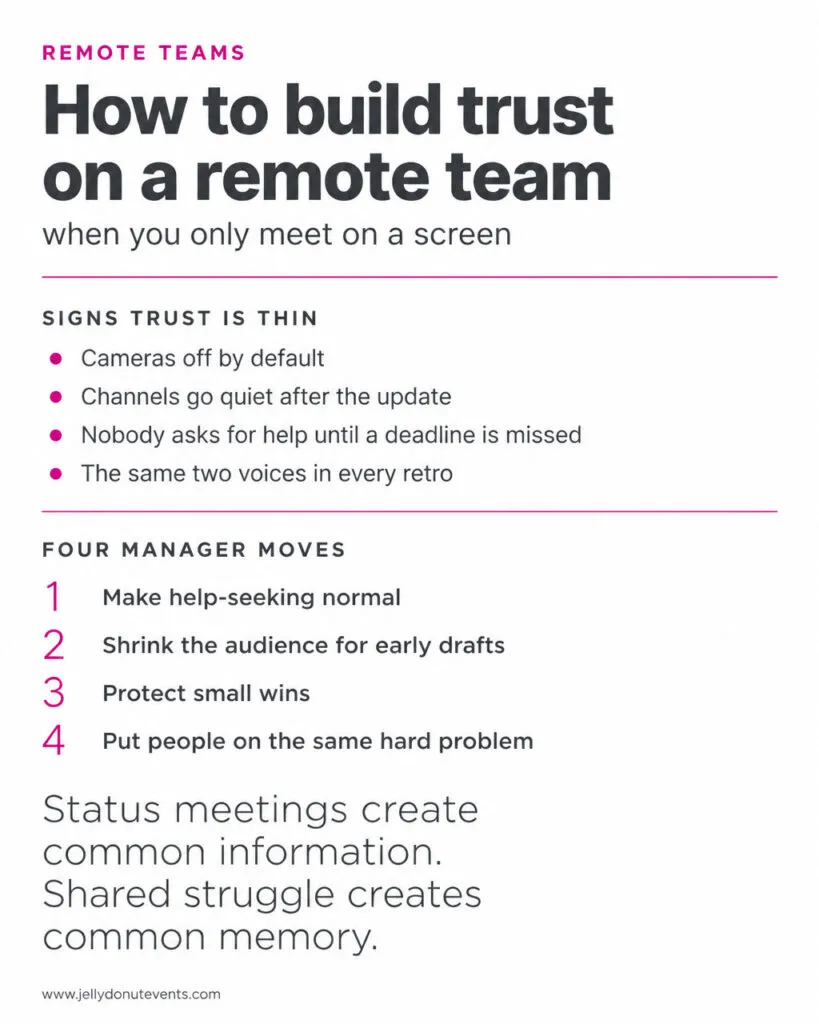
Four signs trust is thin, and four moves that rebuild it.
Why a shared hard challenge beats a forced fun hour
Shared struggle builds the kind of trust status meetings can’t.Forced fun fails when the activity asks for energy without giving people a reason to need each other. A happy hour can be pleasant when the group already trusts each other. When trust is thin, the same hour can feel like another performance. Smile, chat, leave.
A joint hard challenge works differently. Difficulty creates a natural reason to watch someone else’s screen, ask a question, and offer a tip. Progress is visible. The person who was quiet in status meetings often becomes useful the moment the problem is concrete. That usefulness is what people remember later when they need to ping someone about a real deadline.
That is also why virtual team building for engineering teams that actually works tends to resonate with technical groups. The debugging metaphor fits how engineers already think. The deeper point holds for any distributed group. The activity has to produce a struggle people can coach each other through, not just a scoreboard.
Trivia and quizzes can work when run with care and the group already has some rapport. The failure mode is treating them as a trust fix on their own. Trust comes from seeing each other solve something real enough to matter in the moment. A progressive challenge rewards the person who notices what someone else is missing and says so out loud.
Physical kits add another layer when you are figuring out how to build trust on a remote team without another meeting that looks like status. After the call ends, the object stays on the desk. That leftover object gives distributed groups something to talk about later. We have written about how virtual team building with kits improves remote collaboration for that reason. Someone can pick the tool back up later, or mention the hard problem in a one-on-one, and the common memory stays available without another scheduled meeting.
What mutual coaching looks like on progressive locks
I host a Learn Lock Picking Virtual Event for distributed groups. Each person gets a kit with picks, tension tools, and transparent practice padlocks of increasing difficulty. The locks are theirs to keep. I teach everyone on one call, on Zoom or your platform, including Teams. No polls. No breakout rooms. Everyone stays together. The first lock is simple enough that most open it with guidance. Then the next is harder, and that is where mutual coaching shows up. Someone who just felt the feedback leans in to help a teammate still searching for it. The person who was ahead a minute ago is stuck on the next one, and the roles reverse. Progressive difficulty keeps early winners engaged and gives slower starters a clear path. By the end, everyone picks their first lock. I have taught over 10,000 people, and that first-lock success rate sits at 99%.
You do not need lock picking to get that pattern. You need a challenge with an early win, a visible next step, and a reason for peers to watch each other. Lock picking just makes the coaching obvious because the struggle is physical and the feedback is immediate. If that format fits a date you already have, the Learn Lock Picking Virtual Event page has the details, and you can book a session when you are ready.
Putting trust into a weekly rhythm
The practical version of how to build trust on a remote team starts this week. Protect one unfinished-work block on the calendar and treat unfinished thinking as expected output, or book a joint hard challenge on a date you already have so people leave with something to talk about later.

Founder of Jelly Donut Events. Former physical penetration tester and award-winning coffee writer, now hosting live virtual events for remote teams.